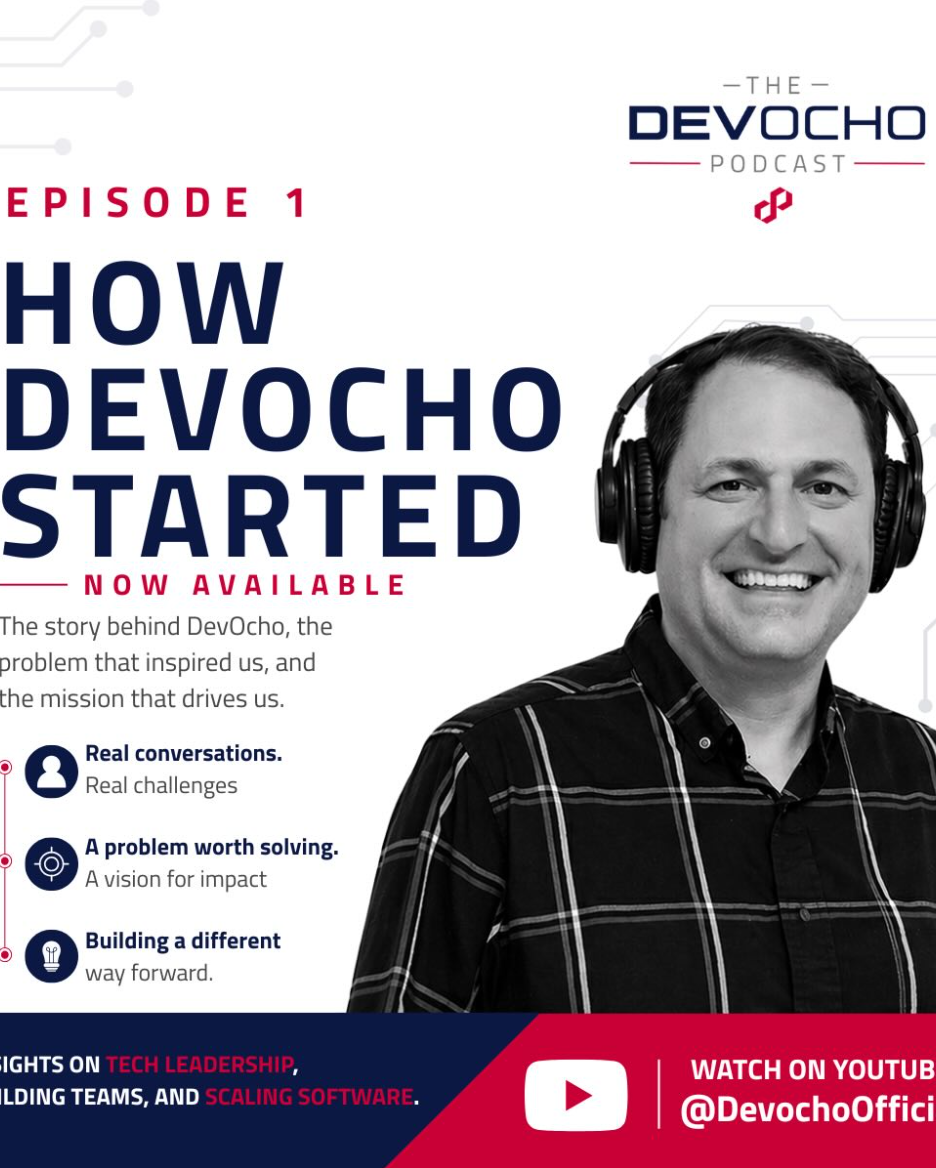
0:14
Hello, my name is Kenny Pyatt and I am the founder and CEO of DevOcho Show. We're starting a new podcast which is kind of exciting. The goal of our podcast is to basically create an an environment in which we can have conversations with tech leadership, CIOs, CTOs, machine learning engineers, people of that that nature. And we want to also just kind of talk about best practices in the industry, not just software development, but how do you lead a project? How do you manage a nearshore or offshore company? How do you approach the buy versus build decisions? So, we're gonna, we're gonna take this podcast and we're going to explore different topics. Obviously, if there's something that you're interested in or you're, or you're curious about at the end of the podcast, we'll have contact information, so you'll be able to shoot a message to us and and tell us what you'd like to hear or you'd like to hear from me. I'll, I'll give a quick a very quick brief overview of me and my my resume, so to speak, who I am. Um, I've loved technology my whole life. Started um working with computers when I was just a kid, eight, nine years old. And for more than 25 years I was a professional chief technology officer vice president of technology or tech leader in companies of various sizes. I have worked in multi-billion dollar companies. I've worked in startups. I've owned startups. I've worked in midsize companies. So, I've really got a, a great I've been lucky to have a a really good breadth of experience there. I've worked in multiple industries. I've worked in healthcare. I've worked in e-commerce. I've worked in like SAAS companies.
1:58
I've got a pretty good gamut there as well. I did a, a couple of years in a really cool company that focused on AI and machine learning, building custom models. So, I've, I've done basically everything there is to do in technology. That's I guess I'm going to I've done just about everything that I would consider moral in technology. There's definitely things that I've not done and will not do, but the the the point of the podcast, the idea of what we're trying to accomplish is we want to talk to primarily people in tech leadership, people that are leading teams, that are building things and doing things. And I, I'm going to try to take a little bit of a coaching approach to this and a mentoring approach to this as we go because I think it's important. I have over 25 years experience getting old and I, I've made a lot of mistakes. I've learned a lot of lessons and I, I want to pass some of that knowledge on. I want to try to help create frameworks and constructs.
2:56
I want to share how I approach problems and how I think about it. I also want to talk about my business. Obviously, we've built a really cool company and we're helping businesses in the United States build really cool software. So, I want to talk about that, but I'm not going to stay focused on that too much. But for this first episode, I do think it's smart to introduce me and to introduce our business. So, I wanted to give a quick overview of myself, which I just did. And now I'm
The Journey to Founding DevOcho
3:24
going to move on to the history of our company and, and kind of why our company's here. So, rewind back to, you know, 2020. I'm working for a really fast growing company, really cool company, and I'm in charge of technology, and we get the same news everybody else got. We want two weeks to slow the spread (COVID-19). So, we took the whole business and we we already had laptops. We were already set up for VPN access. Most of our services were already online. So, we just, everybody went home.
3:54
And my wife and I had been had been very lucky, and, and we'd been saving and investing and we were in a good place financially and I'm, I'm sitting there watching my kids not be in school, their plan, in what was at the time called the longest summer ever. I am working Zoom call to Zoom call to Zoom call and I'm just you know I'm just bored. I get energy from being around people. I get energy from being in in the the struggle in the fight and I just, I wasn't I was in the struggle for sure.
4:24
Sure, I was in the fight for sure, but I wasn't getting that access and energy from people and and again watching my kids play by themselves outside. So, my wife and I had a conversation and we decided, you know, financially speaking, we were in a good spot to, you know, semi-retire and take off a couple years and just kind of let this COVID thing happen. And we did. We sold our home. We bought a sailboat. We learned how to sail because we didn't know how to do that when we bought the sailboat. And we moved to Alabama where the boat was. And we went to work on fixing up the boat, getting it ready to go offshore to blue water, as they say, and hired a captain to teach us how to use it. And that was our adventure. We started um in November of 2020 and then we sailed all the way until the end of 2024 um that we were, we were traveling on the boat. Sold the boat to another family. I, I hope they're doing great. They seem like a really cool family. And it was on that journey that we were traveling by sailboat that we um you know, we left the United States and we went to the Bahamas, and then we just started going island hopping south. And on that journey, we stopped in the Dominican Republic. And when we got here, like, no joke, I just fell in love with the Dominican Republic. And I'm going to give Montse (Editor) a picture of me the first time I ever saw the Dominican Republic. I was on the boat by myself. And I never take selfies. And I took a selfie of myself with the Dominican Republic behind me because it was just, it was so cool. We've been at sea for three days, and you can smell land. I know that sounds crazy, but it smells different than the ocean. And so as you're you're getting closer, you could smell the Dominican Republic come and it was really like a cool moment to see the mountains as we came out of the the clouds and it was just awesome. Anyway, we pull into the Dominican Republic and we're going to explore as we do in each country that we go to and we're there in the city and we're invited to a special presentation by the high school. And the city that we're in is it's, it's really like a small town. The city itself probably has a couple thousand people that live in it. And then the surrounding area, another couple thousand people live there. And so the high school, I'm going to guess that there's maybe a 100 to 200 students in the high school. So not like when I was a kid, my high school had 2,000 students. So not big like my high school, but definitely like to me a very small school.
7:02
Sorry, I'm rambling. The, as we went to the, the presentation, it was in the town square. They had set up a couple tents. We went in and got chairs. They had snacks and drinks and stuff for us. And the, the high school people came out on the stage. And I, I don't think I mentioned this, but my last job before I left for COVID, we were growing like crazy. When I started, there were maybe another 20 employees in the company. And when I left, I, I think we were around 150 employees. So like we had grown just insanely fast. And we were we would basically if you were really smart, you were driven. We were going to try to hire you in our company. So we were always on the lookout, always looking for people, trying to think of people that we knew that could come into that company, hit the ground, and help us keep growing. While I'm sitting there watching that presentation, there was this girl like I'm gonna say junior in high school or equivalent to that age. Maybe she was a senior, but I think she was a junior. I'm not sure. And I remember at this moment in my life, I did not speak Spanish and they're doing a French cultural presentation. I didn't speak French, so I really didn't understand what was going on most of the time, but a lot of it was singing and dancing and so you can just kind of watch. But between each of the, the moments that they would have, each of the little presentations that they would have, there was this girl that would come out and she was like very put together. She had notes. She would know who was in each group. She was sitting there in a chair like straight up, unlike me right now. She was sitting straight up and when it was her turn, she'd get up. She'd walk up front and she'd get the whole crowd excited about the next presentation. And it was a hot day. Everybody's sitting there and you kind of see the energy was low and and this girl who I only know her name because it was in the program they gave us, Rosemary would come out and she would get the whole crowd going and then she would, you know, go sit back down in her chair and she'd be watching for the next event. And I remember thinking like, man, she's like got it. She would be a great employee at Technology Advice if she spoke English if she's in the United States. And so just kind of out of curiosity, I was asking a man that sat next to me from the Navy who spoke English, what will Rosemary do for a job? Like what will she do? And he um just like I'm talking to you, no like hesitation, just, just facts, right? He's just saying facts. He says, "Oh, there's, there's no jobs for her in Luperon.
9:38
There's no opportunities for her here. She will have to leave and she'll leave to go to Santiago, which is the next closest big city, or she'll go to the capital, Santa Domingo, which is a really big city, a little over 3 million people. Um, and that's what she'll have to do. If she's lucky, she'll move to Puerto Rico. And if she's really lucky, she'll go to Miami or New York." And I was like, so she just has to leave her friends and family. And that is the facts. Like that's what she's going to have to do. The only real large business in that area is a a dairy farm and they employ like 20 people making milk, cheese, stuff like that. And he said that that that dairy farm has a wait list of people that want to work there. That's like 30, 40 people. So if Rosemary got in line, it may be a decade before she could even get a job. And I left that moment. I have two daughters. I left that moment and I was like just kind of heartbroken if I'm being honest.
10:43
It wasn't fair to me like why like Technology Advice that company needed people. It needed help. There's this girl that I mean obviously she didn't speak English or I'm pretty sure she didn't speak English. She could not go do that. But there should be the equivalent in the Dominican Republic where she could go get a job and and do well. And they're telling me there's not the equivalent.
11:07
And I go back to the boat and I'm, I'm sitting there on my phone and I, I'm looking up statistics about the Dominican Republic and I learn that unemployment for girls age 16 to 26 is almost 20%. And boys is almost 10%. So if you're a young girl, one out of five young girls there's, there's not a job opportunity for you. There just isn't an opportunity at all. And it broke my heart. I'm on the boat. I'm learning all this stuff about this country I've just fallen in love with. And, I'm like, I started praying and I'm like, God, I don't think this is fair. I think that you need to fix this. And what are you going to do, God? How are you going to fix this? You know, God help Rosemary. God help the Dominican Republic. And I really do feel like in that moment, God said, you know, you could do something about this, Kenny. You can help Rosemary. And I'm like, no, no, no, God. I'm semi-retired. I'm on a boat. I'm exploring the world with my family. This is is not the time that I'm supposed to like do something different. I'm in the have fun part of my life, right? And we just again, we were going south on the islands and in a, in a boat, you have to go where there's not as many hurricanes or you die. So, we were trying to get to Grenada. It's really far south where the hurricanes all go north of you. So, we had to leave. So, we kept island hopping, but I never could let go of of Rosemary and, and what's going on and the lack of opportunities. It just really wasn't it was not something that was getting out of my soul. So, we get to Dominican Republic and I have this idea. I'm going to start a school. #
Inspiration Behind the School and Business
12:59
I can, you know, build some curriculum. I can like go rent a small office and I'm gonna start a school in the Dominican Republic. I'm gonna teach people how to code. I can teach Rosemary um how to code or do QA or maybe she'd be a great scrum master. I don't know, UIUX. Maybe she's got some artistic abilities. You never know. She might be a DevOps person deep down inside and she wants to sit on that Linux terminal and just make magic happen. I, I don't know. But that was my idea.
13:27
I'm going to start a school. And so I, I pull out my laptop and I start writing code again and I start building a training platform and I write five different complete courses on those five areas I just mentioned and I start calling attorneys in the, the Dominican Republic and I start trying to work out how to start a school there. And we take our boat after the hurricanes and all the stuff. We go back north through all the islands back to the Dominican Republic. And we go, I'm not kidding. We go into the end of the island. Um, there's a a place called Samana and we see baby whales. It's the coolest thing if you ever get a chance to do it. And in Samana, I start asking Dominicans, would you want to go to a school that teaches this? Does this sound like a good idea? And the the in Samana they're like yes we would love to learn how to do this but there are already schools there are already places that will teach us this and I was like oh well that's unexpected I don't know why I hadn't thought about that but I hadn't thought of that at the moment and so I start I'm calling attorneys and all the attorneys are telling me we can start a school but it's a very difficult process there there were some issues in the 80s with people doing like scam schools. So, the government has created some very big protections around starting a school. And so, I'm, I'm back to God and I'm like, "Okay, God, You, You put this on me. Go do something. Help these people. What am I supposed to do if I not start a school?" And at the same time, the lawyers are telling me, "You should start a business. What we need is jobs. You should start a business."
15:11
What the guys in Samana were telling me is "You should start a company. We need jobs. We need opportunities." And so I'm slow, but eventually I figure it out. We we take our boat and sail back up to Luperon. One fun fact,100% of the time that we sailed our boat to the DR, it was the best sail we've ever had. And 100% of the time as we left the DR, it was some of the hardest sailing we've ever done. just crazy stuff. I don't think there's anything to that. I just think that's the weather.
15:43
But it is interesting to me that this is where I was supposed to be and it was really easy to sail here every time. So anyway, long story short, we decide we're going to open a company and as part of the company, we're going to use the training material to teach people how we build software.
15:59
And so I went back and I, I went through all of the training material again to kind of specialize it around this is how DevOcho is going to build software. It was, it was really valuable. It's been very valuable for us because we can bring in an employee that already has some experience.
16:14
We can put them through our training so they get a line on our terminology, our technology, our tools that we use, all of our business processes. When you think about like SOC-2 and the compliances um, around data protection, security, all of those things, this training really helps align us and we've been able to create 28 jobs here in the Dominican Republic and we are growing and we are hiring as I record this. So like we're, we're in a good place moving in a good trajectory. We're helping companies in the United States. So that is the reason DevOcho exists. The reason I created this company, and I want to be honest, and I want to be very, very clear. I think the Dominican #
The Mission and Vision of DevOcho
16:59
Republic's going to be perfectly fine. If I never came here, I think they're going to be fine. The Dominican Republic is an awesome country. The people are working hard. They're on their way up. This will be first world nation soon. I don't know when, but it's it's coming. There's too many people working too hard here for it not to happen. So, so I don't want anybody to interpret that. I think that I'm somehow the savior of the Dominican Republic. That is not true. I don't feel that way.
17:27
I feel like there's a, a need here. I have a skill that can, can help meet that need and I'm going to be part of the solution for, for this country, which is really cool. It feels good to be able to help do things. And we've, we found incredibly talented people here. I did not expect that. And I. and I guess I'm an idiot because I should have expected it. There's a lot of very smart people, very skilled people here in the DR. As we talk about this, I, I want to take just a split second to explain the name DevOcho. So I feel like there will be some questions about why like what does that name mean? Does it have a a Spanish meaning? And the quick answer is no. Dev is developer. Ocho is eight. So it's a, a Spanish English mix, a Spanglish word. and and it basically stands for teams of eight people working for customers. And I picked eight because that's the number that came up most frequently when I was doing this work, hiring companies. Like you need a couple of developers, you need a QA person. So you end up with like three developers and a QA, then you put a scrum master, UIUX, and DevOps to kind of round out your team. You end up with eight people. Our projects we end up with anywhere from as little as five people up to I think eleven is our largest project we've done eleven people on the project so and it just depends on what the project needs when you start to get to that larger number it's honestly typically better to do two teams, um, because it gets harder for one person to manage it's harder to segment the work correctly so I, I'll give a quick update on the company we're 28 employees as I mentioned. We, um, we're slightly over a year in operations. We have customers in five different industries now. I think that's right. Healthcare, real estate, um, we have a SAAS customer. We've got a couple of startups and we've got, um, did I say healthcare? Healthcare, oil, natural gas. Just kind of across the board. We've got different industries. We mostly do custom software projects. We will do other things, but that's kind of our sweet spot where we do the best. So, if you need something built and you don't know, um, like if you need to help, we'll help you. So, we are located in Santiago de Los Caballeros and the #
Operational Insights and Team Structure
19:52
Dominican Republic. It's a beautiful city in the mountains on the northern point of the island. It's the second largest city. We picked this city because honestly, my family just loves it. The mayor of the city went on a mission to make the city clean. And there's these people in fluorescent yellow shirts that go all over the city cleaning all the trash all the time. So, it's just a very clean city. It's a very safe city. We, we feel very comfortable here walking down the street. Obviously, it's a city of a million people. I'm from Nashville. There's areas of Nashville I won't walk in. There are areas of Santiago I won't walk in. But, beautiful city. You, you would love it would be awesome for you to come here to meet the team to, to tour the offices to see the company. We would, we would love that. It would be really cool. With our teams, the the way that we work, we have a scrum master who partners with a product owner or a business person in your company that really understands your process and they become best friends.
20:54
The scrum master on our side has a team and he takes your project and he can use members of his team to to make that happen. When we do a project, we, we break the work out into two week sprints. So, we'll make sure that we look at all of your features, what you're trying to accomplish. We'll break those down and and say we can accomplish this in this two weeks, two weeks, two weeks. And then the scrum master will go to work, um, using that statement of work, that plan, that two-week sprint plan as his timeline and his budget. And from there, he'll assign tasks to the team to make it work. And we typically will do a couple of full-time developers depending on your project. We try to maintain a 1:3 QA ratio. So the QA because you can get too much coming in the QA can't test it and they they start testing a little too quickly. So one to three is our sweet spot. Uh, we'll put a UIUX, DevOps, machine learning depending on what your project needs. Um, and then that is a team for us. And right now we, we've got I've been jokingly saying two and a half teams. We're, we're in the process of building out that third team. Uh we work primarily in Python, JavaScript, TypeScript, and C. Those are kind of our core languages we're working in. Now, we're starting just now starting to move into mobile application development and we're doing some, some work there. And I think that's really fun. So, if you have a project or need something, obviously we would help you, but also like I just love to meet people. I love to talk to people. I love to give second opinions. So if, if you want to just shoot me an email or if you want to ask me a question, I'm a very low pressure salesperson. I don't strongarm. I don't demand. I don't try to push people. I probably should follow up more with sales things, but we've got people coming to us right now for work. So, so I'm we're in a good spot and I don't want to, I'm not a pushy human.
22:57
So, if you have a project or you have a question or you want me to look at something kind of in the same way that lawyers, the first consultation's free, we do the same thing. I'll meet with you.
23:07
We'll write our statement of work for free. So, you can get a free plan effectively for me. Um, at some point, I'll probably quit doing that, but right now I will just I'll listen to you. I'll talk to some of your users and I'll come back with a plan for how we would approach it, what it would take for us to build it. When I was, when I was thinking about this and when I switched from it being a school to a business, I wanted to create a business that would would kind of fix all the problems I'd ever had when I hired offshore teams. Um, I've worked with companies in Israel, India, the Philippines, uh, Ukraine, Mexico, all over the place. And there's always, like, friction #
The DevOcho Way: A Unique Approach to Software Development
23:53
points, right? It's never perfect. So, what can I do to, to try to smooth out those friction points? What can I do to create, um, even when I like I led teams in the United States, it's very natural to build software and have very common problem pain points. So, what could I do to correct those or fix those? So I went to work on this idea of a a process where communication is one of the biggest issues that makes projects fail. So let's have intentional meeting rhythms. Let's have intentional communication points. Let's have intentional deliverables at each step of the game.
24:33
And those deliverables communicate this is what we're going to build. So, the way that we do user experience design, the wireframes and the mockups and then annotations that like to explain the mockups, we're intentional about that because I've learned if you're not, what the developer builds doesn't always line up with what the customer is asking for. So, we've created this unique process that we call the DevOcho way. And in our our next episode, the next podcast that we do, I am going to tell all of our secrets. I'm going to explain exactly how we do it. I, I actually kind of hope people will steal this because it's better in my opinion than what most the industry is doing.
25:15
We follow the the agile scrum framework, but we modify it to specifically guarantee, not guarantee, nothing's a guarantee in life, but to nearly guarantee that software gets delivered, customers are happy, and there's value being created throughout the project. So, yeah, that'll be the next episode. It's going to be pretty good. I'm sorry I didn't tell more jokes or more stories. I like to be funny, and I feel like I missed. So, in the next episode, I'll try to have some more humor. It's more energy. I'm used to speaking to an audience and I'm speaking to this webcam right now. So, it just doesn't have that same feel that I'm used to working on, but I promise they'll get more interesting. Podcasts will do better. Could you please, we're going to put out notifications, short clips, and other things on our socials. So, if you could go to our social media and follow, it really helps us out. Helps spread the, the podcast out to other people.
26:11
So, if you don't mind, like on YouTube, follow us. Hit the bell. On all of the other socials, please follow us. It'd be great for you because we're going to keep giving out hopefully great information. And for if you know like a younger tech leader, a newer CIO, or or honestly like anybody that's in tech leadership, that's who we're targeting. That's who this podcast is for. Or, or if you're aspiring, if your dream is to be promoted into management, I have helped a lot of people make that transition. Follow us, reach out. I'm happy to have the conversation with you. All right. Thank you guys. Have a great whatever it is for you. Night, morning, bye.