0:14
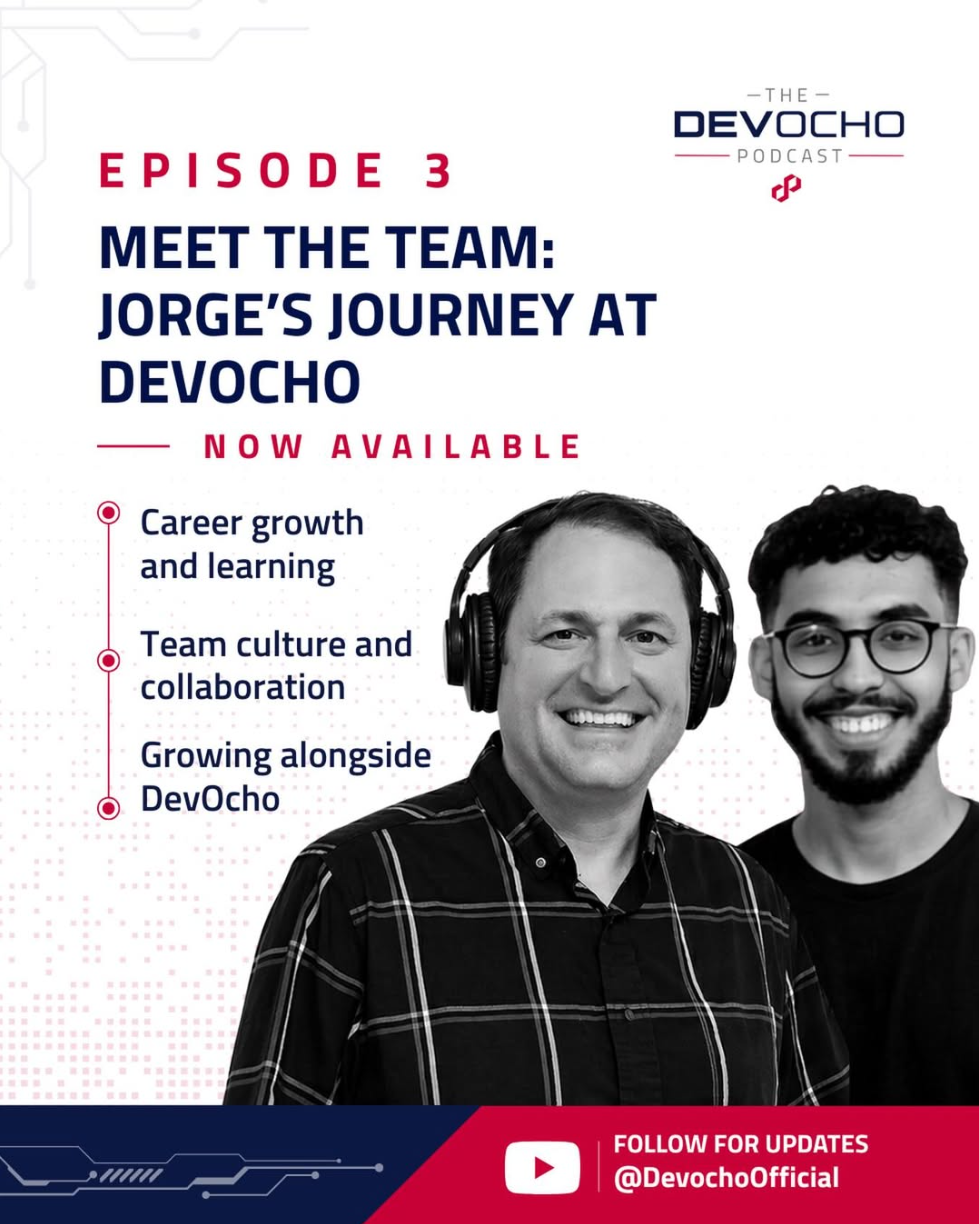
Hello, I am Kenny Pyatt. I'm the founder of DevOcho and I have a special guest with me today. So, Jorge, will you introduce yourself? Sure. I am Jorge Guzman. I am of course from here, from the Dominican Republic. I'm 23 years old and I'm a junior developer here at DevOcho.
0:32
So, we wanted to kind of have a conversation in, in today's podcast about the journey and about Jorge specifically because it's kind of an interesting story that we think people would be interested in and because Jorge is technically our first unofficial employee. I think he was like second actual employee. No, I was the fourth one. Oh, the fourth one. Unfortunately. Who snuck in? Okay, that's fine. That just had to be a paperwork shuffle. Um, because we knew we were hiring Jorge very quickly. So Jorge, let's tell the story kind of about how we met. And I guess I don't know like we can do this kind of in tandem. I'll tell parts that I remember, you tell parts you remember.
1:10
Sure. Um, so my family, if you've watched our other episodes, you know we lived on a sailboat. We were traveling the Caribbean and we came to the Dominican Republic and, and we were, we're not your typical tourists. We were traveling trying to go to where the locals go, trying to to see how societies and cultures live. So, we put our boat in the north coast of the DR. We got in a, a tiny little, uh, bus and we went exploring the city or the country. We got to Santiago and we're driving everywhere and, uh, we're using Uber because Uber is a really good option here in the city or mostly a good option here in the city. Every once in a while you can get a crazy Uber driver.
1:48
But we wanted to go to McDonald's and we were staying in an Airbnb and so we picked up Uber like the American like gringos. We pick up Uber, we pick McDonald's and Jorge shows up. I remember back then my English was not as good as it is right now. So the moment I kind of encouraged myself to actually speak to you, the moment you knew I spoke English, you start like tell me everything that you've done and all the plans you had. That was the very first time that we talked about all this or at least the idea you had. Yeah.
2:20
So the I don't know if I do this. We're going to McDonald's. Jorge like I'm trying I my Spanish was awful. My Spanish is still not awesome but it was awful. And I'm like "Hola, mi nombre es Kenny" like just horrible. And he's like I speak English. Oh. Oh hey cool. Like we can have a conversation.
2:40
and just like literally it wasn't even like two miles from where we were to the the McDonald's and in that two miles I had I knew we were going to travel from Santiago to a city called La Vega.
2:53
And so I was looking for a way to get there and there really wasn't a lot of good options. So I thought, "Hey Jorge, how would you like to do a trip that's not in the app?" And and it's a little risky. I mean I could be crazy. Yeah. But my family was with me so hopefully I don't look as honest. It didn't look like that. Okay. At all. That's why I trusted you. Yeah. So I asked him if he could take us and he said absolutely. And Jorge is super cool. I don't remember telling you how much I was going to pay you. He was like, "Yeah, we'll go. That's fine." And I mean to me back in that moment, it was not about the money. I mean, every chance that I could get to work, right? Why not? So, so La Vega, I don't know how far would you say, like 30 minutes, 45 minutes.
3:37
No, 30 minutes. Yeah. some it's a, it's about like a half an hour maybe a little bit more to go and and and he drove us all the way to our next Airbnb and, uh, we were talking on the journey and I'm just, I'm just a super curious person at that point I really didn't I didn't have the idea for DevOcho yet. I had ideas that maybe something needed to happen that the DR needed some opportunities, but I didn't have this idea. And we're talking and he was in school for computer science and he had a friend that was in school for computer science and we was kind of talking about all those things and I was asking like probably very personal questions and is like sure I'll answer.
4:14
Yeah. Usually people when when you're in that line of work, when you're in Uber, people usually open up to you some reason that I don't know yet. Interesting. So, I remember asking you like salary ranges of what you'd expect to make after school and all these things and it kind of started like adding information to the idea of maybe we should start a business or do something to help. And I remember also the conversation you were having was programming is hard. Yeah, like learning how to do this is is difficult. And I was like, yeah, that's definitely true. So from the moment we met, it took two years or 3 years for me to start the business. I think it was two and, two and a half years, something like that.
5:02
Yeah. So, so tell me your journey like between our first meeting and you working at DevOcho, like kind of what was going on in life. Okay. Well, that at that moment I was exclusively doing
The Path to DevOcho
5:14
Uber. That's all I did because I was also going to college. And after that, I remember I got into a call center, um, in the customer service department and my idea was to get my English better cuz I felt like that was needed. I was working there for one year and three months. Then I and I went back to do Uber because I knew at that moment I already knew about DevOcho and all that was going to happen and you were going to hire me.
5:40
So I just waited for eight months. So we met the first time going to McDonalds, second time going to La Vega the next a couple days later and then it was another year maybe before we saw you guys again cuz we took our boat all the way to Grenada, waited for hurricane season, then came back.
5:57
Yeah. And the, we came back, we hung out a couple times. Yeah. That that was the time we went to the restaurant. Yeah. It was and and and that's at the point where I really had the idea. Yep. At that point, I kind of like this is what I think we should do. Um, we started having conversation with the lawyers and trying to get figured out like how even legally can I start a business in a different country. So yeah, we started to have that conversation. So now that you're here and I remember too we talked about you, uh, coming to work here. Remember your dad was a little skeptical at first like who's this guy? Like what's going on? Not a little. Not a little.
6:32
I mean, he was not into it at all. I try to move slow with that back then because I knew how it looked. It was not he didn't know what I knew. Yeah. So, it was understandable. As a dad, yeah.
6:45
If my daughters are in a a big company stable job and they come to me and go like, "Hey, there's this crazy gringo that's moving here and starting a business. I want to go work for him." I would also be like, uh, I don't know about all this. Like, what's going on? He was not happy. Yeah, I mean, that makes sense. He is now, though. I mean, okay, good. I wanted you to know that he's very happy. Very cool. The, um, I made a deal. Jorge is still like finishing college.
7:08
And I've made the deal with Jorge. I'm not going to be the reason his dad shows up screaming and yell at me. So, college has to be more important than what we're doing right now. So, now that we're here, what's it like to work at DevOcho? How has the experience been?
Working at DevOcho: Culture and Experience
7:24
It's certainly good overall. It's pretty good. One side you have being a programmer which is not easy as you said. But, on the other side you have all the advantages that we have like team buildings like the Free Soda Friday and overall the culture that you brought here is not something that you usually see at least not in the DR here that's not normal. At all. And everyone here knows that. So working at DevOcho is something different but not necessarily bad. So I have to ask like compared to the call center it's very very good [laughter] that, that's a joke since I started working they asking me that since the very first day. Yeah the goal we set was so call center jobs here are, um, some of the jobs that you can get and I've always set the goal of we are going to be better than a call center. I'll talk a little bit about the culture because everybody may not understand some of the terms that you use, but like team building is a concept that everybody would understand, but the way that we do team building is once a month we take a Friday afternoon and we go somewhere fun or we do a community service event. So like last month we went to a, a kids school and we just bought a bunch of toys and things and we went over there and we set up a soccer goal and played with the kids for an afternoon and we just spent time with them. Yeah, I think that was the most important event we did. Yeah, that was pretty cool. And then this Friday, we're going to go play paintball. So, that's fun. Yeah. And we're going to go, this is funny. But we're going to go play paintball immediately after we do a reorganization of like who reports to who and what's going on. And so, I've been making the joke that if I don't make decisions people like, they're going to shoot me a lot at the paintball field. So, hopefully that won't be too crazy. The other thing that he said was Free Soda Friday. So, you want to explain free soda Friday? Yeah, sure.
9:09
Basically the whole company just goes into this space that space that we have here is a big space and one person has to do a presentation about one topic that they understand is helpful for the rest of the company and also there are some other Free Soda Fridays where usually Kenny and the rest of the leaders speak about the current, uh, state of the of DevOcho. That way and I understand that you're letting us know how DevOcho is doing currently. I think it's pretty good. This is an idea I got from, uh, Rob Bellenfant at Technology Advice and I loved it. So I 100% thank you Rob for letting me steal that idea. So basically every every Friday at 4:15 we bring everybody into our our lunchroom which is our largest room. Uh, we used to buy beer and soda, but we had one employee that apparently really can't handle beer. So we decided we're just going to go soda and juices and things like that. It's also more healthy for us. But, um, we buy everybody a soda and we have a quick like 30 minutes meeting and in that meeting we, every other one we do what Jorge said: we have a presentation. I think that knowledge is really valuable. So if you teach us something you can teach the whole company something or maybe teach us that we need to learn more about a topic, that's really valuable. So we want to have a chance to share that. We do pay people for doing presentations. It's not a large amount, but it's a sufficient enough. No, it's pretty good that people want to do the presentation and uh, that's, that's a fun thing. From the very beginning when we were starting our company, our goal was to try to create a really great culture and, and why that's important. I used to work with a lot of offshore companies and you start a project and the company the culture of these larger consulting shops, not all of them but some of them is pretty toxic and the company the people don't want to stay working there. So I would start a project with seven, eight people and by like two months in it'd be like four of those people were different.
11:05
They had hired new people in because those guys had quit. And so I really wanted to create a company that people want to be at and really treat our people right, try to treat them with respect, level up a little bit in the the DR so that we're creating competition so other companies have to do some of the things that we're doing. So we provide lunch every day. We, we have these fun events that we do. Um, we do training and mentoring and other things to try to, you know, create a cool culture. I was going to say that the the amount that we have for the food is actually for, for what I've seen, it's pretty, pretty good. A little bit of above of what companies usually do.
11:41
So, that's I think that will be one of the most important benefits that we have here. Yeah. On top of everything else. So, I'm a little worried about our current setup because we were doing individual meals and then we've just now switched to this buffet, like catered lunch buffet, and I'm, I'm worried we're going to all get fat. So, I'm like trying to figure out how we're going to like, hey guys, don't take too much food. Calm down. Like, cuz it's really good. Yeah. Yeah.
12:07
So, in the like the journey of DevOcho and what we're doing, we've overcome a handful of challenges. We've had some things that haven't gone well. One of the more fun stories that we have. Jorge lived with us through the experience of getting our equipment here for the very first opening of our office. And so I, I think that'd be a fun story to tell. So we, we registered our business in like the summer of 2024, I believe. And it just took a long time for the bureaucracy and everything to get approved. We found our office in the winter, like November or something of that year, signed a lease, got ready to get started, and then it just took another like two months or three months for the inspections and permits and permissions, and I'm waiting. I bought all this stuff and I put it in a storage unit in Texas. And I've got like 25 desks and computers and servers and all of the lunchroom tables and chairs, just all this stuff, enough to fill an entire container. And, uh, we're just waiting for the permission to ship it. And we finally were told we've got permission. We've hired our HR manager as our first employee and we're ready to start and it's it's like February, early February. So, the shipping company told us when we ship the container, it will take a week or two to have the stuff. So, I pull the trigger and we ship everything and it gets to the the country and then I don't, I still don't know exactly what happened. It gets stuck in the port and they won't release it and they keep saying we don't have paperwork we're supposed to have or things that we're supposed to have and so we're having meetings we're working off folding tables and, uh, like laptops that I bought in a local store here and but we're not letting all of our employees start because we don't have equipment for everybody and I don't want to buy all the stuff twice obviously and the stuff I bought in the container was drastically better than the laptop I was buying at this little store. So, finally, we get the word that we're going to get everything. We've hired I think eight or nine people at that point to be our first team. Yeah. And we give everybody a start date of April 1st or second, right at the first first week of April. And, um, and you want to tell the story of the night the container finally came? Yeah. I remember it was a what what was it? Saturday.
14:21
Yes. It was a Saturday. It was supposed to be Friday night. Yeah. Yeah. the Monday of the next on the third, next week it was the first, that we were supposed to start. It was either Monday or, or Tuesday. Yeah. And uh container was supposed to get to the office on Friday at 10 p.m. was it?
14:45
Yeah. It it was no, it was even earlier than that. It was supposed to be there like 6 or 7 o'clock. Yeah. Well, to make to make the story shorter, it basically did it arrived to the office at 1:00 a.m. or something like that. Yeah. So, then it then when we actually had the the truck with the container there, we couldn't open it. We had to wait for someone on the how's that called? Customs. The customs, um, department to arrive so they will open it.
15:17
Allegedly, we, we didn't know what was going on. So basically we had to stay until the very next day. I mean we we slept in my car. Me and Kenny slept in my car. Yeah. So I remember we ordered pizza.
15:29
Yeah. That night. So we were Yeah. Cuz we thought it was going to come earlier. Yeah. And, uh, so we ordered pizza. We're all hanging out at like 5:00 6:00 in the afternoon at the office. Yeah. And the container we can track it on our phone. It's not leaving the capital. It's not moving.
15:44
It's not moving at all. And I still don't know why that was. It sat for like five or six hours. before it started moving. And then when it started moving, we, we kind of like several people left the office. Jorge, myself, and a couple other people stayed. Yeah. And then the it finally arrives at the office and there's four guys in the truck with the container. They're going to help us unload it. And um the customs didn't show up. At all. At all And next day, they didn't show up for weeks later. Long story short, one of the guys with us figures out how to unlock the lock for the customs. Yep. And he opens the container. We break the seal. We had a message from our lawyer saying that was okay. So, we were following the lawyer's instruction.
16:28
And we unload the container. And then we were actually this container was supposed to have shown up like the second week of March. We were supposed to have three weeks to get all the desks set up and the computers and network and everything working. But because it didn't show up for another three weeks, the first day of of Jorge's employment, we were building desks and doing that that the very first of April 2025, it was everyone the like the whole, DevOcho. We were just setting up stuff and and assembling desks and chairs and it was fun, though. Oh, it, it ended up being like very positive for like building our team like we, we all lived through this experience at some point I Yeah, I mean I like I, I wouldn't have planned it that way. I would have actually planned it where we were all organized and everybody shows up on day one and everything's already set up, but that's not the plans that God had. So the fun part of this whole moment for me, like I said, I would never have thought, let's make a container late on purpose so that everybody has to build their own desk. But it's created this kind of fun idea when we ship more equipment here. Everybody's like, well, the new people need to build their own desks. Like we don't do that. But we, we have built a lot of desks in the company. I mean for the, for the second container you had here, we also built we did the second shipment. We as the whole company so it was easier. It was a lot faster. We did it in like an afternoon. Yeah. So the, switching gears now. When we hired
Training and Team Dynamics
17:58
you the promise that I made to you was we have training. We'll put you through our training. Can you kind of talk about the training and how that went? Was that helpful? Like sure. Well, to begin with, I was really scared when I, when I got into DevOcho, or when we started thinking about you hiring me. So, Kenny just told me about training and he explained to me that it was going to be helpful and it had all that I needed to succeed here. Now that I went through it and it has it was like more than a year ago almost. It, it was helpful like it really has every tool that you will need here at least to begin your career inside the DevOcho. It did for me. All the things that I know now all the things that I use here the base the very foundation of thought it's on that training. So that training I would say for this very moment for a programmer it's very, very useful at least for the, for the beginning of your career at DevOcho. So really, really good and that was like if you watched our first episode the original plan was not to open a business. It was to open a training like, like boot camp or a training school where we would do a trade of programming. We'll teach you how to program. We'll teach you how to do QA UIUX those skills. And we learned that there were people here that had the skill but didn't have opportunities. So we pivoted the business, but we had the training. It's beautiful training. And we realized we could take junior programmers and, and help them quickly level up. So our our average is less than 90 days for people in training.
19:36
The more experience you have, the faster you go through it, which, it makes sense. So the training is something that sets us apart from a lot of our competitors as well. Most of our competitors are going to hire somebody, pull them off the street and drop them on a project because that's what they have to do. We hire somebody, we put them through two months of training, and then drop them on a project. So, so it's a little different because we know that by the end of those two months, they know what language we speak as far as how we talk about projects. They know all the tools. They know our process like the DevOcho way.
20:08
Like, they know how we build software. And so it's proven to be insanely valuable. Had I started this idea of building DevOcho just initially as a business, I would have never written that training because I would have thought I'm just going to hire smart people and that's what I'll do. But I was incorrect in that I didn't believe there were going to be a ton of programmers in the Dominican Republic. I just didn't I had a really bad perception, an incorrect perception.
20:35
I had a great perception of the people and that is correct. The people here are awesome. But I had a, an incorrect perception of I'm going to find a bunch of programmers. We've found a ton of programmers. So the training has just become this great onboarding tool that we use. Sorry, we're getting a little longwinded. Talk about um Jorge that like working on a team, what that's like, how we structure teams here at DevOcho, kind of like what's been your experience with the the teams?
21:01
I think, um, the way the teams are built here is one of the two things that have helped me the most and the whole time that I've been here. One would be the training as I just said. The other one is my team. It's like the guys that I work with, without them, I was not going to get very far to be honest. So there's a lot of that training that I really like. I really needed help with some sections of it and being as junior as I am or even more I was back then I really struggled with some sections of it. So my team was there for me in those moments.
21:41
So we we all help each other and that carried on to where to the point that we still do that and the projects even if we are not working on the same project I can go over one of them and ask them about something they will help me having a team of people that that are there to help you not only on the technical part but also to organize you I think is the best thing because I couldn't figure out a way to do it more efficiently. So I, I think yeah working in teams here what would be one of those two things that have earned me to the point that I am right now. I, I love that. So the reason that I wanted to to build teams and, and offer teams to customers instead of just, just a programmer or just a group of programmers. The the idea is you need the whole set of skills to build software. And that means you need somebody that can help plan it. You need somebody that can, can think about the features and the order that you should build things in. You need somebody that's a user experience that's thinking about how can we shave a couple clicks off this process. How can we make this, this screen more aesthetically pleasing so that users know what to do when they first pull it up. You need the QA person that's testing the work and making sure the system works the way it's supposed to work. You need the developer obviously to build it. And it also helps to have a DevOps person thinking about security, thinking about the deployment, thinking about the different environments where the, the software needs to work and be safe and, and safe for users to use and put really mission critical data. So from the very beginning, the idea was we need to have at least five different people available to every project. So we created our first team with that idea in mind and it, it's really proven to be very successful. We, we've done a lot of projects and I, I know from my own personal experience if you don't have all those people together in a room, it's really difficult to get that communication. To have that UI/UX person say like can we move that button a little bit over and can we can we add these things to this form and in the conversation it's like oh yeah, okay sure no problem. Yeah. But when it's just an engineer by themselves, they're like, "Look, it works. Why are you complaining?" Like, I don't understand. But it's not going to ever be as beautiful or as functional as when you have that whole team. A lot of people make the decision to buy, like to build software and then they, they make the decision to save money and they think they're saving money by hiring a a single developer off Fiverr or wherever. And the reality is you end up with a much worse product. There are awesome software engineers that are on those platforms, but because they're not part of a team, they're not getting that like feedback, that support, the collective ideas because you get a lot better ideas from the group. For sure. And you could, you could be the best programmer in the world, you will make mistakes. Yeah. And being in team, it's easier to spot those mistakes. And that that division of responsibilities also makes things easier for the rest of the team because you can focus on what you really have to do and it makes everything more efficient. I love that. All right, last topic we're going to talk about and then we'll say goodbye. And I think right now I'm supposed to say like please follow us on social media, like and subscribe. I think I was actually probably supposed to say that earlier, but, but please do those things. It helps us out a lot. So, the last topic I was going to talk. Jorge has been here basically since the first day we opened the doors.
Growth and Future of DevOcho
25:02
What's it been like? And more recently, we've grown from that initial 10 11 people to 32 people. Kind of talk about what has that been like? I mean, it's been, it's been wonderful. That would be the word I would use to describe the whole thing. You can be honest. You don't have to like just cuz I'm. No, no, no. I mean if if I have to to choose a word for the whole process since the very first day to right now it's been wonderful to be part of it to be here and, and to get to see all the things that we've gone through. If we want to go into more specific it's a bit scary cuz we know it's only up from here and at first we were just 11 to 12 people. Yeah. I mean it was easy to talk to each other to organize stuff those team buildings or Free Soda Fridays or we didn't have as much, as much work as we do now. It's getting like really, really real too fast.
26:00
So for one side it's very good because DevOcho is growing. Um we're getting better day by day. On the other hand it's a bit scary because it's getting like we're getting big and we're doing it fast. Yeah. It's kind of awesome. We we're able to rent the entire floor of a building and we're now hitting the point where we're running out of space in the floor of this building and so we're talking about like we've probably got room for maybe another like 8, 10 people. So what do we do after that? What's the next, the next phase for us? And so yeah, there are moments where we like we don't know. We're still figuring that out. For me the, the thing that the whole idea of the company was to create opportunities. We want to create opportunities here in the Dominican Republic for people like Jorge, but we also want to create opportunities for companies in the United States.
26:46
And so we've had a like a really good opportunity so far this year. We're on track with I hope this holds, but we're signing up a customer basically every month. And for us, like our projects are typically pretty big and require a team to finish the project. So, so you're looking at, like, by the end of the year we could double theoretically from the size we are now to double the size we are now. So, we're trying to make sure we hold our culture. We do a good job on that. We're, we're the reorganization that we're doing is to put some more people in leadership. So, we're building out like a different structure as far as how people report to each other.
27:23
But, yeah, that's the scary part, right? Like we're going to make mistakes and we're going to learn. I think, the reason I think we're going to be okay, we're hiring insanely smart people. We're hiring people that really are good at what they do. The last round of people that we hired are to me are just so impressive and they've so quickly become part of the team and they're doing great work. So I've been really happy with the the caliber of people. And so to me, like if you have a bunch of smart people and you're honest with them, you explain the problems, you explain the situation. Smart people figure things out and they make things happen. And so that's what's, that's what's happening. We're, we're figuring it out. Like it wasn't five months ago. We weren't in this room with our this is you can't see this, but it's our lunchroom that we're sitting in the corner of, but we've got 40 seats for lunch now. We didn't have that five months ago. And we, we were able to rent the this other side of the floor, build it out, put in air conditioners, and, and get the the room set up. And we're going to figure the next step out. We're setting up our first move into hybrid work because we're going to run out of space. So, we're going to need to be able to do some hotel desking while we find our next office. And so, yeah, those are the fun challenges to me. Like, the, we've created 32 opportunities. We've created opportunities for people to have jobs. So far, I think that was that was your main goal. That's right. Originally, and I think DevOcho has been, like, it has been doing a really good job at it. And it's only going up. That's that. Yeah. I mean, the I feel like the growth is exponentially. Yeah. I mean, not quite exponentially, but way faster than I wanted it to be. But it will be we keep going. If we if you're planning to double the size that we have right now and just to the till the end of this year. I'm not planning on it. I'm just saying that's like possible. It's possible. I, I my plan when we started this year was that we'd hit 40 people and we're in May and it's 32. So it that's happened much faster than I expected. So it's possible we'll go past that. The, the thing that's also really cool like we are doing a good job for our customers and I know that because our customers are coming back for second and third projects already and so, that makes me really excited. Our very first customer has has renewed with us for another project that we're talking about. Maybe there's another one. I hope, we'll see. But but we're helping these companies and so that's also really awesome.
29:49
It's not just about building a big company or building a big team. Something that one of my old bosses used to say that I really like, was "If you're a good company, you should grow because you're helping create good jobs. You should grow so more people get to work at a good company.
30:04
If you're a good company and you're helping your customers, you should grow so you get to help more customers, right?" So that's our goal. We want to be a good company. We want to help people. We want to want to put the right people on the right projects. Deliver for everybody.
30:19
We want to make sure we're intelligent and smart about how we grow so that we're stable and safe. One of the hardest things like as a, a founder is it takes a lot of cash to grow a business.
30:30
And so far we're bootstrapped like I put up the initial money and, and we've just been financing as we go. But there is a point where if we keep growing at this rate like we're going to have to be wise with, with money or go into debt. And I don't love going into debt. As somebody from Dave Ramsey's hometown, I am supposed to not go into debt. So yeah, there there's some challenges and, and to me like it's cool to have people like Jorge working with us to help us. And again, I hope I do a good job. I really try to lead very transparently. This is the problem, guys. This is what we're trying to solve. Please help me solve this problem. So you've been doing a good job.
31:05
I think that is what what's keeping people, um, motivated. And more than that is just to have a good job overall. Yeah. because it's pretty much better than the overall opportunities that we have here based on, on everything that you've explained and the vision that we have, the values, keeping values as we grow. Yeah, we've got to maintain our values. That's important and we've made a good work with the 32 employees that we have at the moment. 30? 32 32 32.
31:33
So yeah, I think for now DevOcho is the best it can be for the moment. It's even better than what you expected. So, yeah, I'm, I'm excited about it. All right. Well, thank you guys so much for watching. Thank you, Jorge, for we pulled Jorge off. He was working on bugs for a customer and he's supposed to release it today, so he's a little stressed about getting back over there. Yeah, [laughter] thanks for the invitation. Yeah, thank you for for joining the podcast. So, all right guys, thank you very much for watching. Have a great day. See you later.