0:13
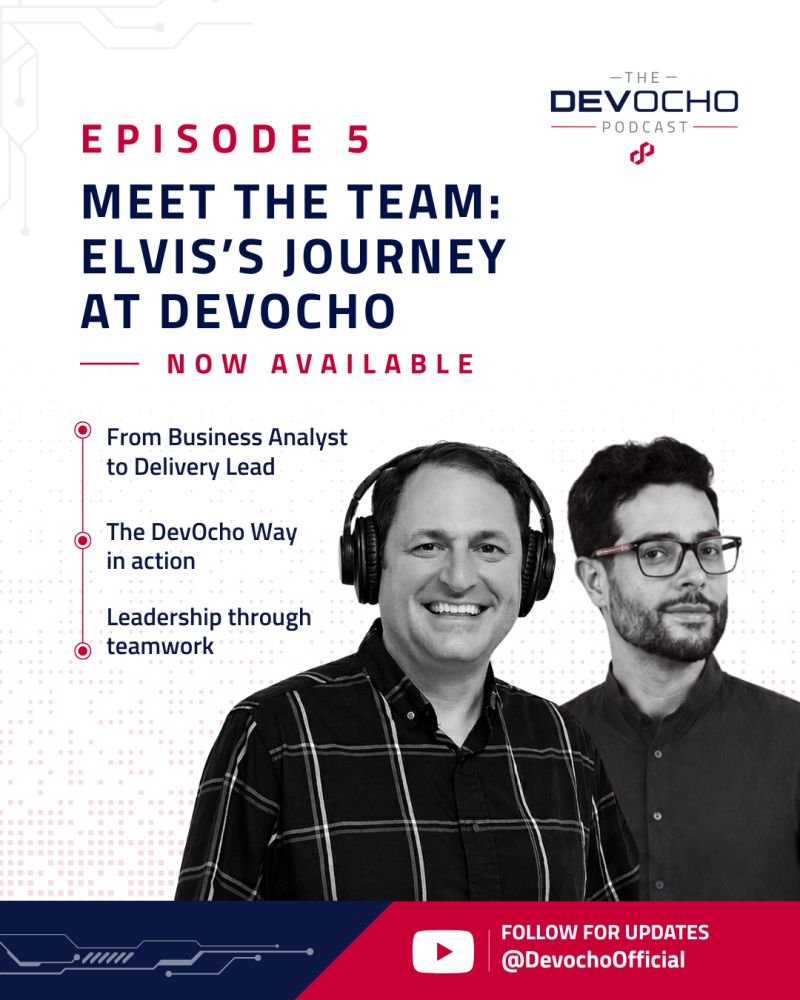
[music] Hi, my name is Kenny Pyatt. I am the host of the DevOcho Way podcast and the founder and CEO of DevOcho. And today I'm with Elvis. Elvis uh Sahad is uh one of our delivery leads here at DevOcho, a position that was only 15 minutes ago known as Scrum Master. The the format of the podcast is just going to be I'll interview you, ask questions, and um everybody will get a chance to get to know who you are. So, if if it's okay, will you give like the introduction to Elvis? Who is Elvis? Sure. Um yes, my name is Elvis. It's not a very common name in the States. It is very common here in the DR. And if you get to work with us, there's a very good chance that you will meet me in maybe a user interview or maybe I'll get to know the project or whatever we're going to build for you. So yeah, hope we get there some point. But yes, I am the scrum master and now delivery lead on DevOcho. Yeah, the so I was thinking about like the idea that the customer might get to meet you is true in a few months because right now there's no way. Yeah, Elvis has a lot of projects. There's no way a new a new customer today would meet Elvis. A new customer in the spring could could potentially meet Elvis. It's possible. The um I don't know though, even now as I say that, I don't know if you're going to be free in the next like 10 months, 12 months. But anyway, so I I I think it'd be fun to kind of go back um in the whole story and talk about like how we met and just kind of what was your experience like becoming aware of of Kenny and DevOcho and what was that like? Yeah, sure.
1:54
Um I remember we had a mutual friend that Yeah, it was a friend from church and she was telling me about Kenny about this American guy came into the Dominican Republic. She kind of told me about
How Elvis first discovered DevOcho
2:07
his story. I didn't believe her much. Uh it was bit crazy. I do believe her now [laughter] and I have pictures. So I was very interested in this idea that he wanted to build here in in DR. So I told him like, "Hey, I need I need to meet this guy. I'm very interested in the position and what he's going to make here." It was a for me if you guys know Kenny you will understand why I say that it was some it was like a dream because it doesn't really sound real. So I I said I really want to be part of that. So main idea so my memory of Elvis like we first I had so Leonela is our friend right. Leonela had introduced me to the idea that you might be interested in a job. We had a meeting in a coffee shop and I don't drink coffee so I had a Coke. Yeah. Um, and we kind of talked about what you were doing. At the time you were working somewhere else, which totally fine, but um, I uh, remember having a conversation with you and thinking like, yeah, I think Elvis could be really good at this kind of work cuz you've done a similar things leading up to this and I thought you'd be like pretty solid. And so we invited you to come and interview and at the time like we're a startup and we didn't really have our office established. And if you've watched our first YouTube video, we didn't have anything at all. It was in a shipping container stuck in customs. And so I went to PriceSmart. I bought a couple folding tables. I bought a couple folding chairs. And we had rented a house. Another long story that didn't work out, but we were in the house. We set up a couple folding tables and chair. And it was me and it was Sagrario, our HR manager. And Elvis shows up to this house and we interview. So what was that like? Like that experience? Well, the thing that
Interviewing at a startup before the office existed
3:56
was weird for me was like it was a house. Yeah. It was not a structure like a workplace and it was like where am I? Am I the right place? But I like no sign nothing like we're just in a house. But I I actually liked it because I I get it start so things will not be ready as soon as you get there.
4:14
So yeah, honestly I thought it was How did you feel about the interview? I didn't tell you I was going to ask you that question. Yeah. Actually, [laughter] I I loved it. Um because I remember in the interview, you mentioned some of the things that you wanted to build and part of the dream that you wanted to accomplish here and I felt like it was something that again I really wanted to be a part of. So once the interview started, I forgot all about the house and I was more into man this sounds neat. Cool. So I love it. I love it. So, so tell us like your journey and I don't I don't mean from like I was born in Santiago. I mean like maybe from college your professional journey.
Elvis's journey into technology
4:59
What was that like? Yeah, since I was young I was always into computers. I feel like I was raised more on my computer than outside in DR. So I was very much into American culture and games, software. So I knew from the story that I was going to do something with technology. So once I got to college, I decided Sorry, you said No, no. Yeah, that's perfect. That's perfect.
5:26
I didn't. [laughter] No, I think that's perfect. Um, that explains the why, right? Yeah. I wanted to be a programmer and God knows why I decided to try maybe something more customer facing and it was in my previous job and I really liked it. It was a business analyst role. I I still did some database database SQL and things like that, but I really like the customer facing side. I really like talking to customers and taking necessities or problems and translating that into actual things that people could work on like my programmer team, they could take those and build a solution for them. It was really awesome. So I thought maybe there's something here. I need to go and see if this is something that I think will be for me. No, that makes sense. And and also like we've got a joke that we kind of I tease Elvis that sometimes I think he's more American than I am.
6:24
And uh so so I want to have some fun with that for just a second. And we we just took a trip to Nashville recently. We've got several customers in Nashville and Elvis came and and we were going to different restaurants. And I I guess actually this was your first trip to Nashville. You were introduced to a new type of food. Um do you want to talk about that? Sure. So here in the DR they give me a hard time. I mean everyone here all the Dominicans cause I don't like aguacate. That would be avocado. Avocado. I don't like them. And they say well you're not Dominican cuz you don't like that.
7:02
But turns out that I really like gravy. So, it was it was the one thing that I told Kenny, "Kenny, we need this in the DR. We need to get this to the DR." [laughter] I don't know why. I just really like gravy. So, yeah. I I I love it. Uh Gravy's awesome. We were, we were in Franklin, Tennessee. And the I don't remember the name of that restaurant. It's a breakfast restaurant. Super popular. It's kind of a chain restaurant. And uh we're sitting in the restaurant and this girl comes up and and Elvis is like I'm trying to decide between two things and she's like 100% get the gravy. And so he's like, "Okay." And so he gets it and we're we're having kind of like a business breakfast talking to a friend of mine that that's a CIO. And Elvis is like, you can see him just like, "Oh my gosh, Kenny have you had this?" Like this is crazy good. That was awesome. I love I loved that.
7:57
That was a cool moment. Okay. So, back to your journey. You're business analyst and uh we meet, we make you an offer, you give your notice and um we we were the the process that we were going through was we needed a person in each one of the different specialties because I believe strongly that it's better to work in a team where you have different like skill sets and disciplines.
8:20
So Elvis was going to come be our scrum master now delivery lead and he was going to kind of lead the project side of the teams and while he was giving his notice at work we hired I guess like 11 other people. Yeah. And um so Elvis shows up to work as employee number 12. Uh and that was April of last year. April 14th. Yeah. Yeah. And so we officially open the office until April 1st. So all the employees start on April 1st, but Elvis is I can't remember how long your notice was. Like two weeks. Two weeks. So Elvis gave his notice. Two weeks later he comes in to work. And um so I mean that's just kind of I guess the the whole wrap of the story. Elvis has been with us since basically the beginning of DevOcho. So I I would be really curious and I'm going to put you on the spot.
9:11
What like what is the DevOcho Way and why is it so important like and especially for your role? Yeah, I remember once I met Kenny, he explained to me or he went over what is scrum because I didn't even know what scrum was then and he told me it is basically a proven process of how we
Understanding the DevOcho Way
9:33
build software in what we call sprints. We do not plan everything. We plan small sections of the software or the workflow or whatever we're going to do and we do that and then we go to the client and we ask did you like it? What do you think? Is this something that you feel is a necessity to you or maybe you want to show something? Maybe you don't feel the same way two weeks ago that you felt two weeks ago. Sorry. And where you've learned something because a lot of times you learn as you're building. Yeah. So to me it totally makes sense. I said yes I I have seen before that sometimes plans just don't work out. You plan something and then 6 months later you notice hey this is not actually what we needed but we could just take those six months and do it again. So it made a lot of sense but not only Kenny decided to use that he modified it to what he calls a DevOcho Way. So because I'm not marketing creative like that was the best name I could come up with. Yeah. [laughter] So I really feel like it is an improvement over scrum. It is still scrum but it is a major improvement and I think even now we I I feel like we are going to keep improving it. We're going to make changes to it because I feel like obviously is never going to be perfect but it is so much better than things I've been done before is is nice. Yeah.
10:59
And I like I'm I'm super opinionated about this because I've I've done a few times in my career. I've gone to companies and you know becoming the CTO or the vice president of technology, I come into the company and they've got a way they're doing things and the reason I'm being hired is because it wasn't working and I'm trying to turn it around. And so I've seen it go wrong so often or I've had people like, "Oh yeah, yeah, we do agile. We do scrum." and and I'll get there and I'll look at what they're doing and it's it's like they do the daily standups and they have tickets and I yeah that's totally the right thing and that isn't the process. We've also added a couple things um to the process about how we we work with customers. We're very like very picky about what is in a ticket, what is the definition of done? Like all of these ideas, what's the definition of ready? So we do have some strong opinions that we we do for customers. we don't necessarily share that with everybody, but there's a whole other podcast if you're really curious about the DevOcho Way. You can go check out that other podcast. Um, so, so keeping the the conversation going, why like I guess why is it important that we work on teams from your perspective? Why, why does that matter? I think we are better when we are when we segment or divide the issue.
12:19
For example, if you just assigning an issue or a software because software is basically something
Why specialized teams build better software
12:23
to solve a problem and you assign that to someone, the issue maybe has different parts that needs to be solved and not everyone is best at everything. Some people will be better at something and others will be better at something else. So assembling a team of people that can be best or very good at specific roles and putting them all together and just setting them loose, I think is the best way to tackle these things. And this is what we do at DevOcho. We have different roles. Some roles are twice, maybe three people or four people in the same row, maybe just one one role. For example, DevOps most teams only have one. And yeah, it works. Yeah. So the premier tenant of the idea of agile and scrum is that you have a team where all of the capabilities exist on that team. So I I remember I went to work for a company and it's a huge company super cool and I love them still. But when I got there they only hired developers. So they would have a team with 10 15 developers and and multiple teams. This is a really big company. But an engineer is only going to see something from an engineer's perspective. That perspective is there's room in this top corner to put one more field. I'll just shove it up there. Or no, this button like when you click it does some obscure thing that's not obvious, but the engineers like it's perfectly obvious. And so to me, like taking an engineer but partnering them with like a user experience designer who's going to sit there and go, what is the user going to think when they click that button? or what are they going to even think that button would do? Like that changes the game a lot. And then like you said the DevOps like a lot of times engineers are really good at frontend or they're good at backend as far as like backend is like databases or frontend is interfaces. Maybe they're really good at both of those but they're not good at actually deploying it on a server. And so by bringing some specialty DevOps guys are focused at least at DevOcho they're focused on security. So we did DevOps and Dev Sec Ops. And so they're thinking about those things. They have tools that they run. They're watching the software by putting all of that together. I'm sorry, Elvis, this is your interview and I'm getting all excited about it. Just makes a better product at the end of the day. And I think that's the way software should be built. I think we weren't like I don't think God made us to only one guy builds everything. I think God made us to to work together. And so I think we do a good job at that. All right, Elvis. I want to the last question I really want to talk to you about and then I'm going to ask a bonus surprise question. Um, so last April we had 11 or 12 employees. Fast forward today we like have 35 employees. We have 12 open positions right now. So to talk about just in the last year like we've we've basically tripled in size. What's that been like from your from your side? Like it's it's so different. Every the way I feel today will be so much different than how I will feel in two to three months because the whole company will be different.
15:40
It will be maybe double in size. Who knows? I don't know. So, so I remember at first it was
Scaling from 12 to 35 employees
15:46
obviously it still feels like a family. There's it's still a small company. But at first we were like 10 people. So, well, when I came it was more like 12 or 13. So you could if you wanted to look for someone you could just go to them in like two seconds and say say hey someone I need someone from you something I don't know but it will be quick and it will be fast it's not like that anymore right now if I want to book a conference room I actually need to book it. [laughter] So that's fair when we first started you can just like we'll just walk over jump in a conference room. Yeah just jump in a conference room doesn't matter. So new challenges will come out of that but it's just part of growing and there's also things that will get easier because we will have more people to help us tackle the issues that will come. So because of course being a very small company has it issues and those will be solved eventually with more people help. We um this is fun to me. We started a small group. We got our first customer. We started building stuff and um we we like there's a rule in our industry that we're supposed to keep a certain number of people on the bench like in a you know baseball, basketball, football team, you've got the backup guys sitting over there. And so we get this first customer we're building and we realize like we don't have a bench so we need to hire a couple more people. And so we we start interviewing and hiring people and the new group comes in and then we land another customer and takes the whole group and all right well I guess we need to go hire some more people because we're supposed to maintain a bench and so we go out and we find some more people and every time we hire we put people through training and we're having like our our good issue is we're delivering software we're really helping uh companies so that's starting to get out. people are referring their friends to us and then it's like oh snap we can't hire fast enough no to keep a bench and and it's such a good problem but at the same time it also is kind of stressful and like at the beginning of the podcast I was talking about you won't be working with Elvis anytime soon because we limit our scrum masters no more than three projects so that they're always able to focus and know what's going on and we we do fractionals that's something a lot of our competitors don't do. So you go and and you want to hire a team. They want to sell you a full team of, you know, 5 to 12 people depending on your project, right? And and you're like, I don't need a full-time DevOps. And most of our competitors are like, no, that's just that's what we do. And and we won't we're willing to say like we can take only 25% of a DevOps time and put them on a project so they've got four projects they watch. And sometimes we can't. Sometimes the projects are too too big. You have to dedicate a full person to it, but when we can, we we will do fractional. And that creates another challenge of keeping everybody busy and having backup people and and doing it. So, we've actually gone crazy and built our own software to help us do that because that makes sense. All right, so the bonus question, what is your favorite restaurant in the United States? Oh, man, that's an easy one. It is a....What do you call that? It's an embarrassing truth. Um. Oh, I thought you were going to say fast casual. [laughter] No, no, no, no. Is Chipotle. Um, my dad took me to Chipotle and he he told me like, "You're not going to believe me how big this burritos are. [laughter] It was awesome." So, at one time
Favorite restaurant in the U.S. and closing conversation
19:21
I also had two at the same same day. So, at the same time, every time we go to the United States, Elvis's like, "We've got to stop at least once. We got to stop at Chipotle." And we've done that.
19:31
I've held that up. So, I like Chipotle. I don't have any problem with it. I saw that was really fun. We need one in the DR. Yeah, we like what's going on with that can be the next thing. Yeah. Oh, start a Chipotle in the DR. I think I'm going to stay with focused on on software. I know that industry a lot better. I I did like So, funny side story. I've always been an investor and I've always been an entrepreneur. And when Chipotle started as a restaurant, I can't remember now.
20:00
Um, so Chipotle was a relatively new company and they had like 10 or 12 locations or something and I found them and I saw that they were growing and I was looking at what they were doing. I was like, "Oh man, this is brilliant. I'm going to open a Chipotle in Nashville and I'm going to be rich."
20:17
And I don't remember exactly why I didn't do it. I don't like debt, so it could have been something associated with that. There was some reason I didn't open the Chipotle. And now I'm like, "Oh, I should have totally opened that Chipotle. [laughter] I would have done so well." I got the investor packet and I talked to them. I did all the things and then never did it. And it's like, "Oh, man. That would have been brilliant." Cool. Elvis, thank you so much. I uh appreciate you.
20:43
Uh I'll get in trouble with the marketing team if I don't say please like, subscribe, all the things that you do on social media. So, please do all of those. And also like watch a couple other podcasts. It's informational. We've got basically two formats now that we're doing. We do this interview style. So you can watch like the last one that was interviewed was me and Jorge.
21:03
Jorge was one of our first employees. The first Dominican programmer I ever met. So if you want to watch that one, that's a good one. Um there's also we've got podcasts on how DevOcho got started, The DevOcho Way, and I did one recently on AI agents. So there there's a lot of good content out there. Go watch those and enjoy. And please also shoot me an email or or comment or say something.
21:23
We love that cuz it gives us a chance to know, are we doing a good job or a bad job? And if you don't like something, let us know that as well. We've recently upgraded our lights, our cameras, we bought microphones. So, like, we're getting better. Hopefully, we'll keep getting better. So, anyway, Elvis, thank you so much and thank you guys for watching. [music]